
How home solar works
Panels turn daylight into electricity, an inverter makes it usable in your home, and your meter counts what you draw from the grid and what you send out. Your savings depend on how much the panels make and how much of that you use.
Last checked November 12, 2026. Sources are linked in the text and listed at the end.
What are a kW and a kWh?
A kilowatt (kW) measures power: how fast electricity is being made or used at one moment. A kilowatt-hour (kWh) measures energy: one kW running for one hour. A quote sizes the system in kW and promises output in kWh a year.
For scale, BC Hydro describes a typical home system as about 7 kW, making about 7,700 kWh a year, and an average household as using about 10,000 kWh.
How do panels make electricity?
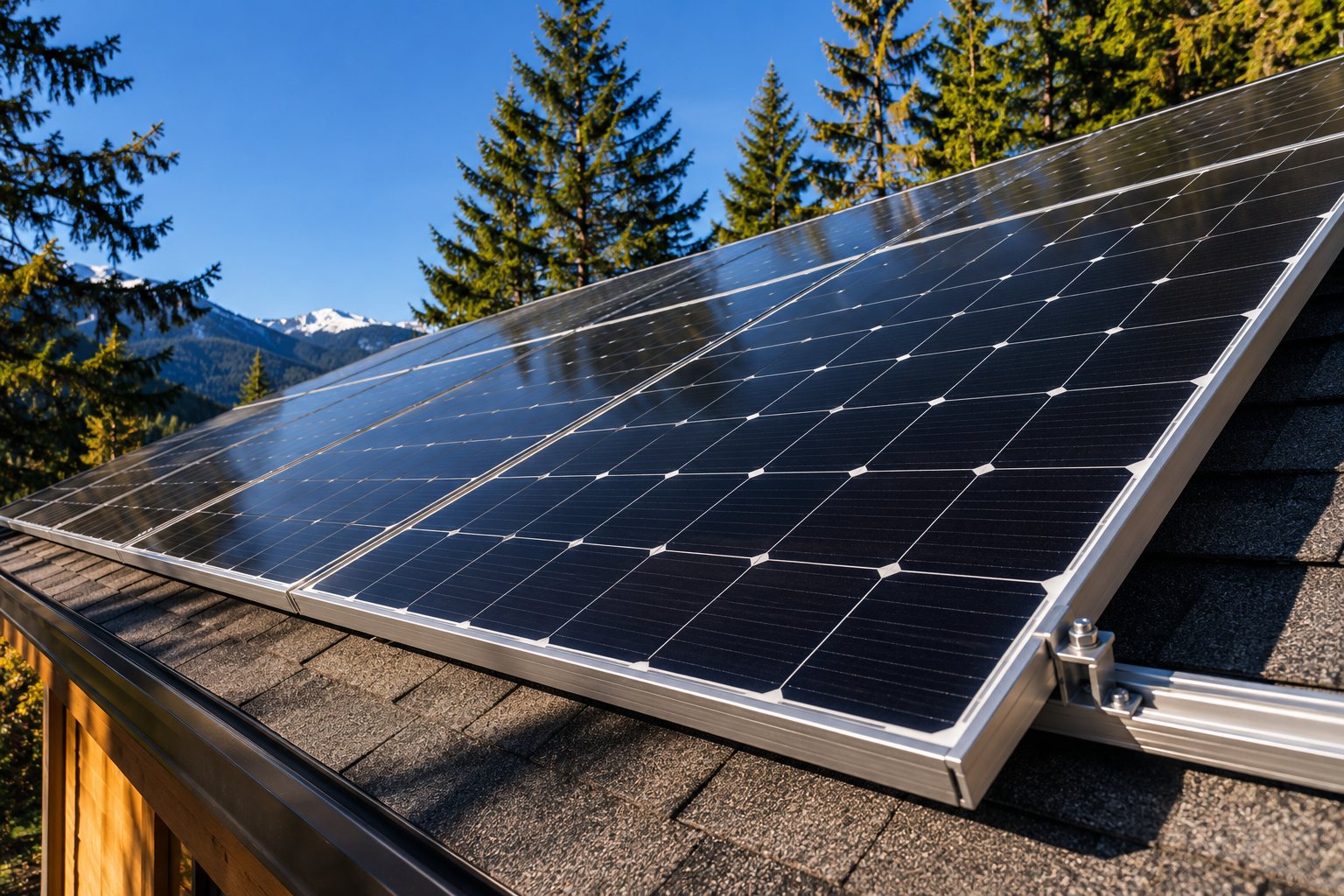
A panel is a sheet of solar cells. The US Department of Energy explains that the semiconductor in a cell absorbs light and passes the energy to electrons, which flow as a current. About 95% of panels sold use silicon.
BC Hydro's typical system is 7 kW from 16 panels, about 440 watts a panel. On a quote, the panel count times the panel wattage should equal the system size.
Panels lose a little output each year. Our model uses 0.5%, the median in a 2013 review of nearly 2,000 measured rates from the US National Renewable Energy Laboratory. Natural Resources Canada uses about 0.6%. At 0.5%, a panel makes about 88% of its first-year output after 25 years.
What does the inverter do?
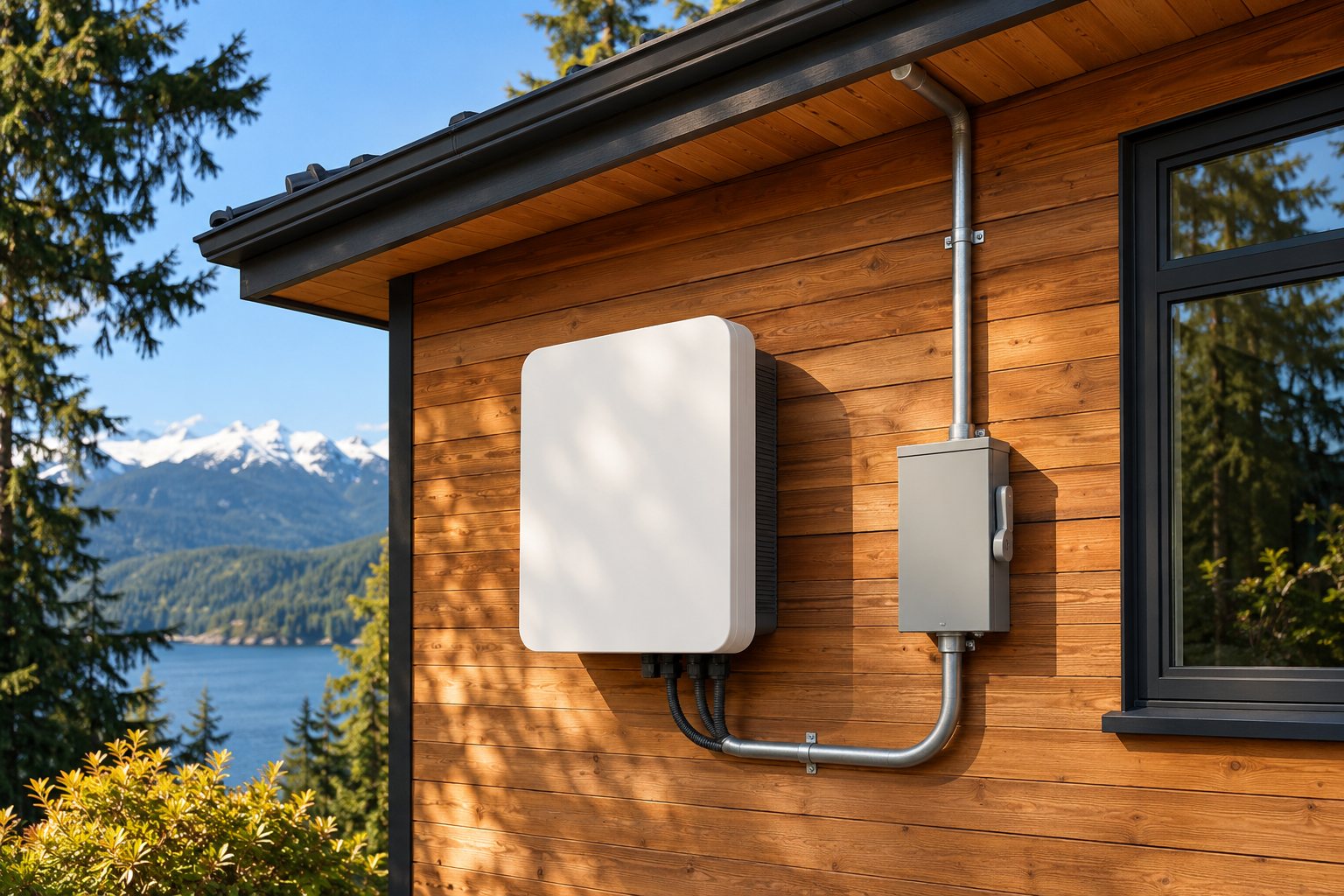
Panels make direct current, and your home and the grid use alternating current. The inverter converts one to the other, in one of three layouts.
| Layout | How it works | If one panel is shaded | Cost |
|---|---|---|---|
| String inverter | One inverter serves a string of panels | Output of the whole string drops | Lowest |
| Microinverters | A small inverter on each panel | The other panels are unaffected | Can cost more |
| Power optimizers | A device on each panel tunes its output, and one inverter converts it | Losses from shade and mismatch are reduced | Higher than a plain string system |
The comparison draws on the US Department of Energy's inverter basics page and a 2015 case study, which found per-panel electronics recovered 20% to 35% of the energy lost to partial shade. BC Hydro keeps a list of qualified inverters, so a quote should name the model.
How does the meter count your power?
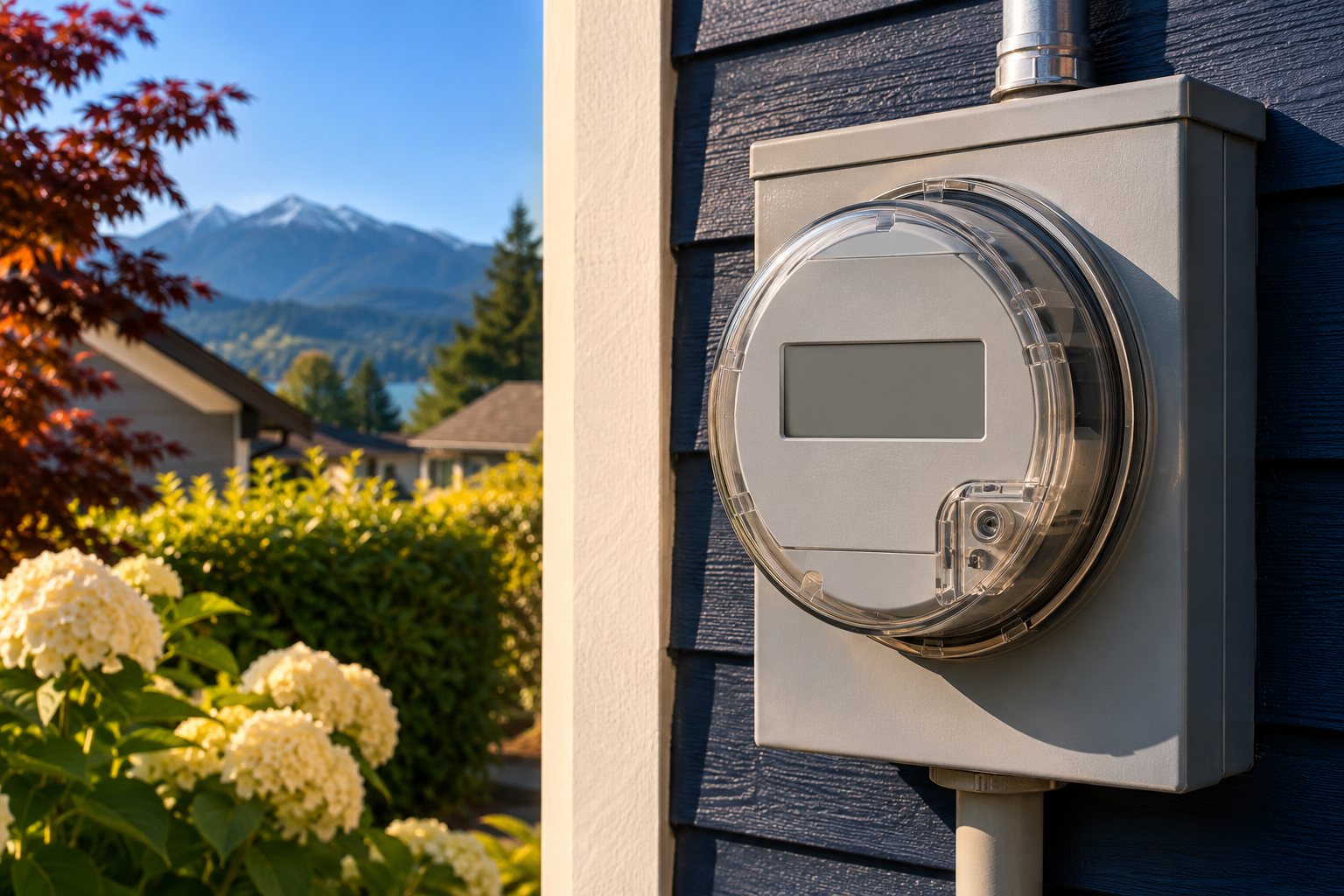
Solar power feeds your home first, and only the excess passes the meter. BC Hydro says the meter measures what you draw and what you send, shown on the bill as "consumption" and "generation to the grid". An inverter app shows different figures for that reason.
Under the self-generation rate, the two are netted over each billing period, and any surplus is credited at 10 cents per kWh. BC Hydro's example is 50 kWh of surplus becoming a $5 credit. Our rate guide works through a full year.
What does a battery do in BC?
It stores power for later the same day and can run chosen circuits in an outage if the system is designed for it. Panels alone generally shut down when the grid does. A battery does not carry summer surplus into winter or change the 10 cent price. Our battery guide has the arithmetic.
What decides how much a system makes?
Where you live, which way the roof faces, its tilt and how much shade falls on it. Our free calculator starts from one figure per region for an unshaded south-facing roof.
| Region | kWh per kW per year |
|---|---|
| Metro Vancouver and Fraser Valley | 1,050 |
| Victoria and southern Vancouver Island | 1,100 |
| Central and northern Vancouver Island | 1,030 |
| Okanagan and Thompson | 1,180 |
| Kootenays | 1,200 |
| Northern BC | 1,080 |
These figures run from 1,030 to 1,200 and are approximate. BC Hydro's typical system works out to 1,100. Natural Resources Canada publishes solar potential maps for more than 3,500 municipalities and says a system's lifetime average should land within about 10% of the mapped value.
Natural Resources Canada also publishes a figure for each municipality, for a south-facing surface tilted at the site's latitude, with no shade counted. Its figures sit a little below our regional ones in most of BC, so treat ours as the upper end.
| Municipality | kWh per kW per year, Natural Resources Canada |
|---|---|
| Vancouver | 1,007 |
| Surrey | 997 |
| Abbotsford | 997 |
| Victoria | 1,091 |
| Nanaimo | 1,063 |
| Kelowna | 1,132 |
| Kamloops | 1,156 |
| Nelson | 1,116 |
| Cranbrook | 1,217 |
| Prince George | 1,056 |
From the municipality table of the federal solar potential maps, as held in our benchmark file on November 12, 2026.
A roof facing east or west makes less than the same roof facing south, and shade lowers output further.
Have a quote in hand?
Multiply the system size by your region's figure and compare it with the kWh the quote promises. Our free price check and paid reviews go further.
Common questions
What is the difference between a kW and a kWh?
A kW measures power, the rate electricity is made or used at one moment. A kWh measures energy, one kW running for one hour. Systems are sized in kW and bills are charged in kWh.
Are microinverters better than a string inverter?
It depends on the roof. A string inverter costs less. Microinverters or optimizers handle each panel separately, which helps when panels sit on several roof faces or get uneven shade.
Sources
We read every page below on November 12, 2026.
- BC Hydro: self-generation
- BC Hydro: net metering and the self-generation rate
- US Department of Energy: solar photovoltaic cell basics
- US Department of Energy: solar integration, inverters and grid services basics, updated March 31, 2025
- US Department of Energy, Building America: photovoltaic systems with module-level power electronics (PDF), September 2015
- National Renewable Energy Laboratory: photovoltaic degradation rates, an analytical review, 2013
- Natural Resources Canada: photovoltaic potential and solar resource maps of Canada, modified January 16, 2025
- Solar Second Look: how we check a quote
General information, not engineering advice. Photographs on this page are generated images.